 Bloomprint
A watering schedule for houseplants
Plant care · Updated August 5, 2026 · 2 min read
Short answer
A fixed schedule alone does not work — the same plant may want water every 5 days in a sunny room and every 15 in a dim corner. The table below gives starting intervals; you then adjust for pot, light, temperature and season.
On this page
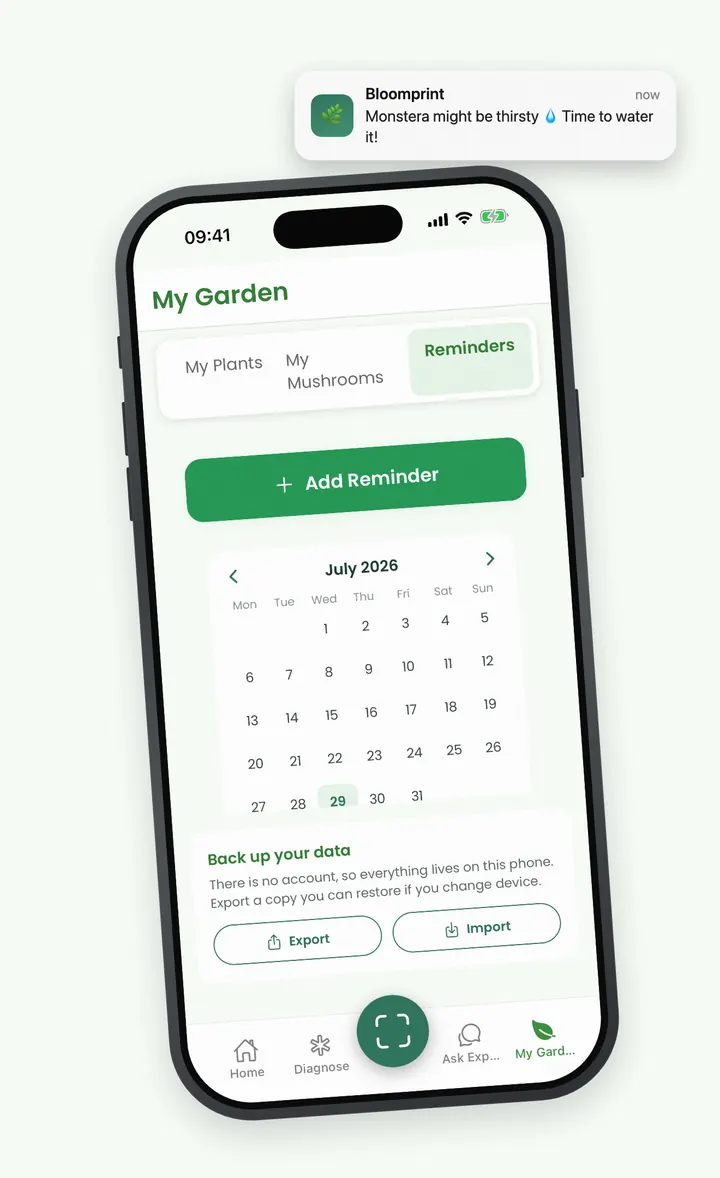
A watering schedule works — as a reminder, not as a rule. The calendar tells you to check; the soil tells you whether to water.
Starting intervals
In bright indirect light, 18–24 °C, in a plastic pot:
| Plant | Spring–summer | Winter |
|---|---|---|
| Snake plant (Sansevieria) | 14–21 days | 30–45 days |
| ZZ plant (Zamioculcas) | 14–21 days | 30–45 days |
| Succulents and cacti | 10–14 days | 21–42 days |
| Pothos | 7–10 days | 12–18 days |
| Monstera | 7–10 days | 14–21 days |
| Philodendron | 7–10 days | 12–18 days |
| Peace lily (Spathiphyllum) | 5–7 days | 8–12 days |
| Calathea / Maranta | 5–7 days | 7–10 days |
| Ferns | 4–6 days | 6–9 days |
| Orchid (Phalaenopsis) | 7–10 days | 10–14 days |
| Yucca / Dracaena | 10–14 days | 18–25 days |
| Aloe vera | 14–21 days | 30–40 days |
Five things that change the interval
1. Pot material. Terracotta is porous and dries about twice as fast as plastic or glazed ceramic. Move a terracotta plant one step more frequent than the table.
2. Pot size. In a large pot, the soil the roots do not occupy stays wet for a long time — hence "bigger pot, less frequent watering".
3. Light. Water use follows light. A plant in a south-facing room drinks roughly twice as fast as the same plant facing north.
4. Temperature and humidity. A dry, heated room speeds evaporation; a cool, humid one slows it.
5. Season. In winter, days shorten and plants slow. Continuing the summer rhythm through winter is the most common way houseplants die.
Calibrating for your own home
You can find the right interval for any plant in three waterings:
- Water thoroughly and note the date.
- Do the finger test daily; write down the day the top 3–5 cm dries.
- That number is your starting interval. Re-measure when the season changes.
Technique
- Top watering: pour until water runs out of the hole, then drain fully. This also flushes accumulated salts.
- Bottom watering: stand the pot in water for 15–20 minutes. Good when soil has become water-repellent, because it wets evenly. Top-water once a month anyway to flush salts.
- Water in the morning. Soil left wet overnight raises the risk of rot.
Going away
- Up to a week: one good watering covers most plants.
- Two weeks: group plants together in a bathroom, out of direct light but not in the dark; evaporation slows.
- Three weeks or more: wick watering or self-watering pots — or leave only drought-tolerant plants such as snake plant, ZZ and succulents.
Frequently asked questions
Can I water everything on the same day?
Picking one day and checking everything then works well — but checking is not the same as watering. Check on the same day and water only the pots that have dried out.
Do I need to let tap water stand?
Not for most plants. For species sensitive to chlorine and fluoride — calathea, maranta, dracaena, spider plant — standing the water overnight or filtering it makes a visible difference.
Are moisture meters useful?
Cheap analogue meters measure conductivity and are thrown off by fertiliser residue, so they indicate rather than confirm. The finger test and pot weight remain more reliable.
Should I feed in winter?
No. A slowed plant cannot use fertiliser and it accumulates as salt in the soil. Feed monthly from early spring to late summer only.