 Bloomprint
How to diagnose plant disease from a photo
Plant identification · Updated August 5, 2026 · 3 min read
Short answer
A photo shows the pattern on the leaf: the colour of a mark, its edge, its distribution and which leaves carry it. That narrows the cause considerably. What a photo cannot show is the roots, the soil moisture and your watering history — which is why a good assessment asks about conditions as well.
On this page
When a plant is struggling, the only data most people have is a picture. Getting from picture to cause is possible — but it takes asking the right questions in the right order.
What a photo can show
- The pattern of colour. Is the yellowing even, between the veins, or stippled?
- The edge of a mark. Sharply defined, blurred, or ringed in yellow?
- The position. Tip, margin or middle of the leaf? Old leaves or new growth?
- The texture. Dry and crisp, or soft and wet?
- Pest evidence. Webbing, sticky residue, white clusters, brown bumps.
- Overall posture. Drooping, upright, stretched?
What a photo cannot show
Without these three the diagnosis is incomplete, and this is where most attempts go wrong:
- Root condition. Root rot is below the soil; above-ground signs only hint at it.
- Soil moisture and watering history. The same yellow leaf means overwatering in wet soil and thirst in dry soil.
- Environment. Light intensity, room temperature, humidity, and any recent change — a move, a repot, the heating coming on.
This is why a good diagnostic flow asks for conditions, not just a photo.
Symptom map
| What you see | Likely cause | First check |
|---|---|---|
| Lower leaves evenly yellow, soft | Overwatering | Is the soil wet? |
| Leaf edges dry and crisp, brown | Thirst, dry air, salt build-up | Is the pot light? |
| Green veins, yellow between | Magnesium or iron deficiency | When was it last fed? |
| Pale brown patches with sharp edges | Sunburn | Is it in direct sun? |
| Dark wet-looking spots with yellow halos | Bacterial or fungal spot | Do the leaves stay wet? |
| White powdery coating | Powdery mildew | How is the air circulation? |
| Pinprick stippling plus fine webbing | Spider mites | Look under the leaf |
| Sticky residue, ants | Aphids or scale | Check shoot tips |
| Silvery streaks with black specks | Thrips | Check new leaves |
| Drooping in wet soil | Root rot | Lift the plant out |
| Stretched stems, small new leaves | Not enough light | How far from a window? |
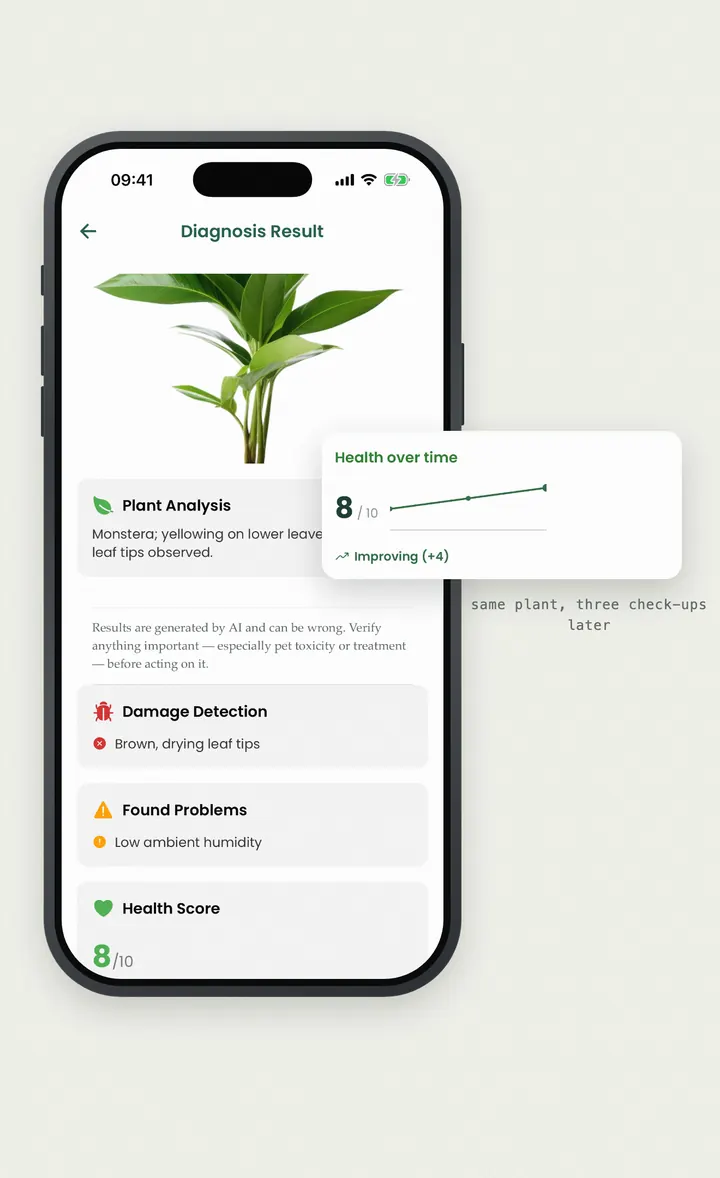
Taking the right photos
Take four frames:
- The whole plant with its pot. Posture and the distribution of damage show here.
- A close-up of the affected leaf, upper surface, with the mark's edge and colour clear.
- The underside of the same leaf. Most pests live there.
- The soil surface. Mould, algae, white salt crust and gnats are visible here.
Use daylight and skip the flash; glare erases the edge of a mark.
Three common mistakes when reading symptoms
1. Reading one symptom alone. Yellowing on its own points to seven different causes. Yellowing plus wet soil plus soft texture points to one.
2. Ignoring timing. "When did it start?" often supplies the answer. Did you move the plant two weeks ago? Has the heating just come on? Was it recently repotted?
3. Acting immediately. Intervening on a wrong diagnosis — watering a plant you assumed was thirsty — usually accelerates the problem. If you are unsure, waiting a day is safer than a step in the wrong direction.
The limits of photo diagnosis
An assessment made from an image is a ranked set of possibilities, not a verdict. If the plant is valuable, the symptoms are progressing quickly, or the problem is spreading between plants, consult a specialist. And for questions of toxicity or edibility, no photo-based assessment should stand as the basis for a decision.
Frequently asked questions
Is one photo enough?
Usually not. A close-up shows the mark but not how the damage is distributed; adding a shot of the whole plant makes a clear difference.
Should I cut off the marked leaves?
Damaged tissue does not recover, so you can remove it for appearance. With fungal and bacterial spots, removing affected leaves also slows spread — wipe the scissors with alcohol between cuts.
Several of my plants have the same symptom. What does that mean?
Look for a shared environmental factor or a pest that travels: dry room air, a change in water, the heating, or spider mites moving plant to plant. Separate the affected ones and check leaf undersides.
How will I know if the diagnosis was wrong?
Look at new leaves two to three weeks after making the change. Clean new growth means the cause was right; the same symptom on new leaves means the diagnosis was incomplete.