 Bloomprint
How to identify a plant from a photo
Plant identification · Updated August 5, 2026 · 3 min read
Short answer
Photo identification compares leaf shape, venation, stem structure and any flowers against known species and returns a ranked list of probabilities. How good that result is depends mostly on the photo: one plant, sharp focus, daylight and a plain background raise the hit rate substantially.
On this page
Identifying a plant from a photo automates what a botanist does: leaf shape and margin, venation pattern, how leaves sit on the stem, stem texture, and flowers or fruit where present. A model compares those features against known species and produces a ranked list of probabilities — not a verdict.
That distinction matters in practice: the result is an estimate, and its quality depends heavily on the photo you give it.
Seven rules for a good result
1. One plant in frame. Two plants side by side make features blend together. Separate the one you want, or move closer.
2. Fill the frame with the leaf. The leaf carries the most information: shape, margin, venation, texture. Let it fill at least half the frame.
3. Shoot in daylight. Warm indoor lighting shifts colour, and colour is a distinguishing feature in many species. Next to a window is enough.
4. Do not shoot into the light. With a window behind the plant the leaf becomes a silhouette and all texture is lost. Put the light behind you.
5. Simplify the background. Patterned wallpaper, carpet and other foliage add noise. Holding a plain sheet of paper behind the leaf improves results markedly.
6. Check the focus. Phones frequently focus past the subject in close-up. Tap the leaf to lock focus before shooting.
7. Include any distinguishing organ. A flower, fruit, stem spine or the underside of the leaf is often decisive on its own.
What the confidence score means
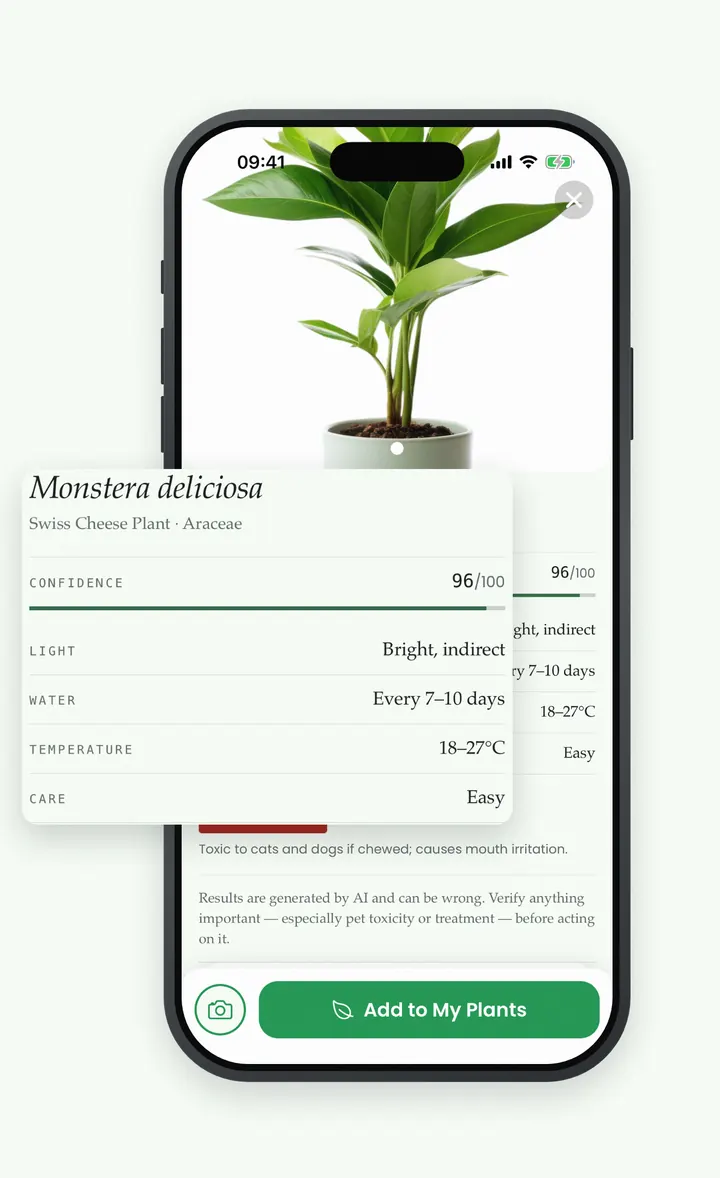
The score reported alongside a result is the model's confidence in its own guess — not a guarantee of accuracy.
| Score | How to read it |
|---|---|
| 90–100 | Species is very likely right; still verify for critical decisions |
| 70–89 | Genus probably right, species may be uncertain |
| 50–69 | Treat as a lead only; try another photo |
| Below 50 | Change the photo: different angle, better light, add a flower |
The commonest reason for a low score is not that the plant is rare. It is that the photo was not good enough.
Where identification goes wrong
- Cultivars. A single species may have dozens of ornamental varieties whose differences do not show in a photo. The model can get the species right and the cultivar wrong.
- Juvenile plants. In many species young leaves look nothing like mature ones — Monstera is the classic example.
- A single detached leaf. Out of context, one leaf matches dozens of similar-leaved species.
- Flowers alone. A flower is a strong clue but misleading by itself; photograph it with foliage.
- Damaged plants. Yellowed, dried or chewed leaves have lost the features that distinguish them.
How to verify a result
Rather than accepting an identification outright, run three checks:
- Search the Latin name and compare the images against what you have.
- Test the care profile. If the result describes a full-sun desert plant but yours has thrived in a dim corner for years, the identification is probably wrong.
- Repeat with a second photo. A different angle producing the same answer raises confidence considerably.
When not to trust a photo
Photo identification is not sufficient on its own for edibility or toxicity decisions. Among wild mushrooms and wild plants, toxic species resemble edible ones to a surprising degree, and the cost of being wrong cannot be undone. Use app results as a starting point, never as the basis for a decision.
Frequently asked questions
Can a plant be identified from a leaf alone?
For most houseplants, yes — leaf shape and venation are distinctive enough. For wild plants a single leaf often is not; flowers, fruit or stem detail are needed.
Can a dried plant be identified?
Rarely well. Drying costs a leaf its colour, texture and often its shape. If the plant still has one sound leaf, photograph that instead.
I got two different answers for the same plant. Which is right?
They are usually closely related species in the same genus. Take a third photo from a different angle, in better light and ideally with a flower; an answer that repeats across attempts is more trustworthy.
Does identification work offline?
Bloomprint runs the analysis on a server, so identification needs a connection. Your saved plants, reminders and history are stored on the phone and remain available offline.