 Bloomprint
Monstera care: a complete guide
Plant care · Updated August 5, 2026 · 3 min read
Short answer
Monstera wants bright indirect light, watering when the top 5 cm is dry, and a free-draining aroid mix. When leaves fail to split, the reason is nearly always low light or a young plant — it has nothing to do with watering or feeding.
On this page
Monstera deliciosa comes from Central American rainforests, where it climbs tree trunks. The higher it climbs the more light it gets, and the larger and more split its leaves become. Nearly all of its indoor care follows from that behaviour.
Light
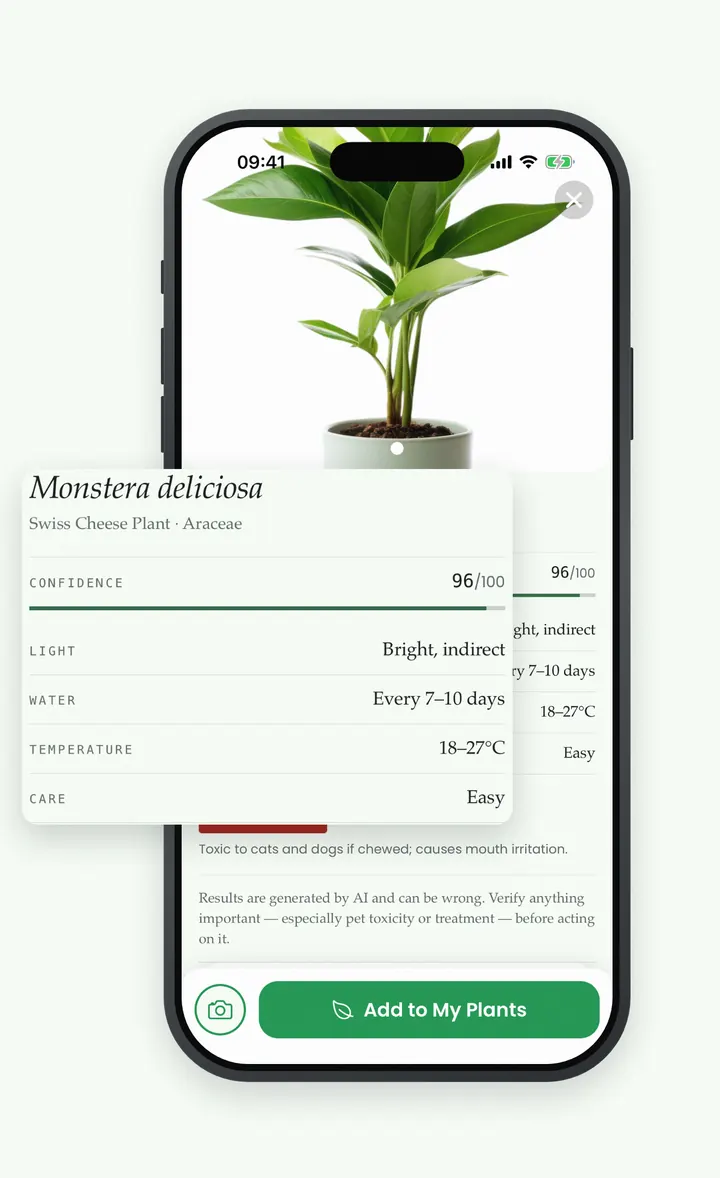
Bright indirect light. Near an east or north-east window is ideal; behind a sheer curtain on a south or west aspect. Direct midday sun scorches leaves and leaves brown patches.
Signs of too little light: stems stretching, gaps between leaves widening, new leaves smaller and without splits.
Water
Water when the top 5 cm of soil is dry. In practice:
- Spring–summer: every 7–10 days
- Winter: every 14–21 days
Water until it runs from the drainage hole and let it drain. Tip out anything left in the cachepot within 15 minutes.
Soil
Standard potting compost is too heavy. A good mix:
- 2 parts houseplant compost
- 1 part pine or orchid bark
- 1 part perlite
- half a part coco coir or worm castings
The aim is a mix that holds water while keeping air pockets.
Why are the leaves not splitting?
The most asked Monstera question. Three reasons, in order:
- The plant is young. Early leaves are always plain and heart-shaped. Splits usually begin after two to three years and past a certain leaf size. There is no way to hurry it.
- Not enough light. A mature Monstera in a dim corner reverts to producing unsplit leaves. Fenestration is the plant's way of letting light through to lower leaves; with no light to spare, there is no reason for it.
- No support. A climbing Monstera produces larger, more fenestrated leaves than one sprawling on the floor. A moss pole or stake gives aerial roots something to grip and pushes the plant into its mature growth mode.
Watering, feeding and humidity do not determine splitting. Their effect is limited to general health.
Feeding
Once a month through spring and summer with a balanced liquid feed at half the labelled dose. Do not feed in winter, and wait six to eight weeks after repotting — fresh mix already contains nutrients.
Repotting
- When: every one to two years, in spring. Once roots appear through the drainage holes, or the soil no longer holds water.
- How much bigger: one size, 3–5 cm more in diameter. Two sizes up keeps the soil wet far too long.
- How: loosen the root ball gently, remove any rotten roots, and set it at the same depth in fresh mix.
Humidity, cleaning and pruning
- Humidity: around 50% is ideal, but Monstera copes at 40%. Dry rooms can produce brown tips.
- Cleaning: wipe the leaves monthly with a damp cloth. Dust measurably reduces the light reaching the leaf.
- Pruning: cut yellowed and damaged leaves close to the stem. To limit height, cut the leading shoot just above a node.
Propagation
Monstera propagates from a node. A single leaf may root but can never grow; the cutting must include a node — the swelling where an aerial root emerges.
- Cut 2–3 cm below the node with a clean blade.
- Root it in water or in damp perlite and moss.
- Pot it up when roots reach 5–7 cm.
- Water-grown roots take a few weeks to adapt to soil; keep it slightly damper during that period.
Frequently asked questions
Is Monstera toxic to pets?
Yes. It contains insoluble calcium oxalate crystals, which cause burning in the mouth, heavy drooling, vomiting and difficulty swallowing in cats and dogs. Keep it out of reach.
Should I cut the aerial roots?
No need — they help the plant anchor and take up water. You can trim them for looks, but guiding them onto a support is better.
No new leaves are appearing. Why?
In winter that is normal; Monstera pauses in cold, dim conditions. If nothing appears in spring either, the usual causes are low light, a root-bound pot, or soil that has not been fed in a long time.
What do brown patches on the leaves mean?
Dry brown patches starting at the edges point to low humidity or irregular watering; soft dark patches in the middle point to overwatering; pale brown patches with sharp edges are sunburn.