 Bloomprint
Is Monstera toxic to cats?
Pets and plants · Updated August 5, 2026 · 2 min read
Short answer
Yes. Monstera deliciosa contains insoluble calcium oxalate crystals, so a cat that chews it gets immediate burning in the mouth, heavy drooling, pawing at the face and often vomiting. It is painful but rarely fatal — and unlike true lilies, it does not cause kidney failure.
On this page
The short answer is yes. The longer answer is about how serious, because toxic plants differ enormously in severity and Monstera is not in the dangerous group.
How the toxicity works
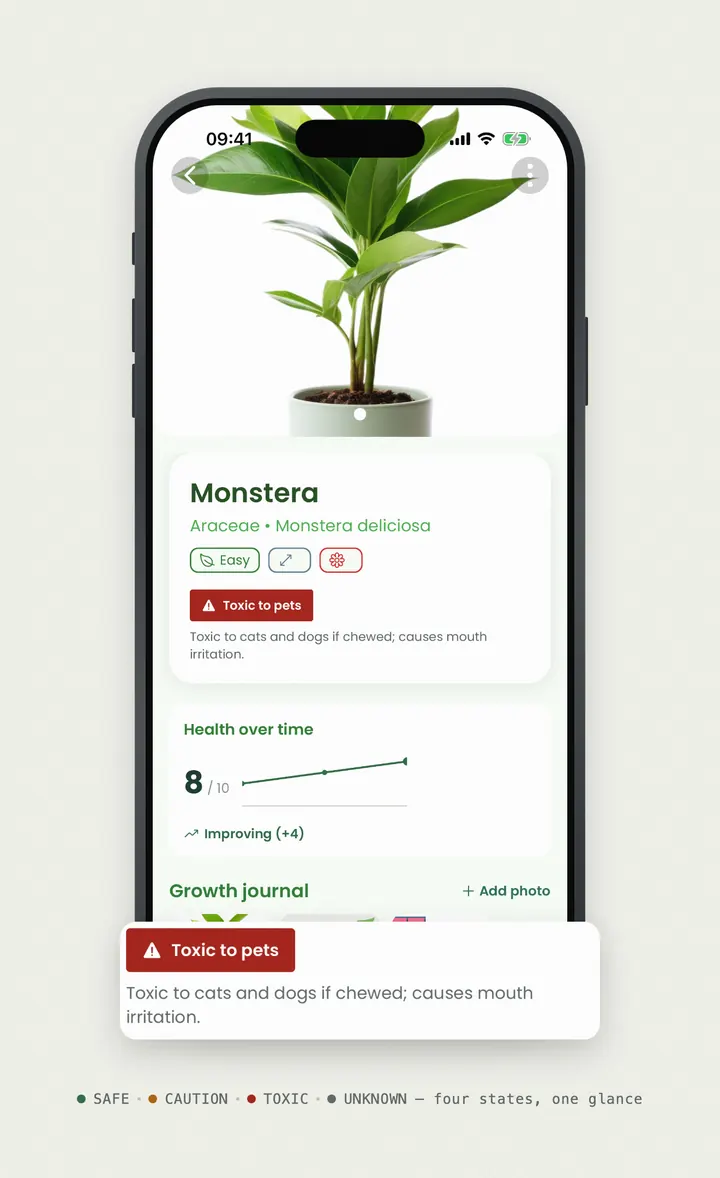
Monstera tissue contains needle-shaped calcium oxalate crystals called raphides. When a cat chews a leaf, these embed in the soft tissue of the mouth and cause immediate mechanical irritation. It is not a systemic poisoning; it is a contact injury.
That has a practical consequence: symptoms start immediately and the cat usually stops eating, so the pain limits the dose by itself.
Symptoms
Usually within minutes:
- Heavy drooling
- Pawing at the mouth, head shaking
- Redness and swelling of the mouth and tongue
- Difficulty swallowing, loss of appetite
- Vomiting
- A change in voice or difficulty vocalising
Rare but serious: marked swelling of the tongue or throat and difficulty breathing. That needs emergency care.
If your cat has eaten some
- Remove any plant material from the mouth.
- Rinse the mouth with lukewarm water; a little milk or yoghurt can ease the burning.
- Do not induce vomiting. Bringing the crystals back up through the oesophagus makes the irritation worse.
- Call your vet. Even with mild symptoms it is right to inform them; go immediately if there is swelling, breathing difficulty or vomiting lasting more than two hours.
- Take a piece of the plant with you. Species information directly affects treatment.
Do not confuse this with lilies
For cat owners this may be the single most important distinction:
| Monstera | True lily (Lilium, Hemerocallis) | |
|---|---|---|
| Effect | Contact irritation in the mouth | Acute kidney failure |
| Severity | Painful, usually temporary | Life-threatening |
| Dangerous amount | Limited to a bite's worth | A few leaves, or even pollen |
| What to do | Inform your vet | Emergency vet |
Cats and lilies should not share a home — including cut flowers in a vase.
Keeping cats away from plants
- Height and inaccessibility. A hanging pot is the most practical answer.
- Give the cat its own greens. Cat grass satisfies most of the urge to chew leaves.
- Scent. Citrus peel and rosemary deter some cats, though it varies.
- Foil or double-sided tape around the pot puts most cats off.
- Cover the soil with coarse gravel to stop digging and soil eating.
Frequently asked questions
My cat only licked a leaf. Is that dangerous?
Licking rarely causes more than mild irritation. Still, watch for a few hours for drooling or pawing at the mouth.
How long do the symptoms last?
Mild cases resolve within a few hours to 24 hours. Prolonged vomiting, refusal to eat or drink, or any swelling means calling your vet.
Is it the same for dogs?
The mechanism and symptoms are the same. Dogs can eat larger amounts, so vomiting and difficulty swallowing may be more pronounced.
Do I have to get rid of the plant?
Not necessarily. If your cat ignores plants, moving it up high may be enough. If the cat keeps chewing it, removing it is the only certain fix.